ERIK BLOODAXE
KING OF NORWAY · KING OF NORTHUMBRIA
A NAME EARNED IN BLOOD
They did not give him that name as an insult. They gave it to him because it was true.
Erik Haraldsson was the son of Harald Fairhair — the man who had done the impossible and
united all of Norway under a single crown for the first time in history. A father like that casts a
long shadow. Most sons would have struggled to step out of it.
Erik did not step out of it. He picked up an axe and carved his own shadow instead.
Harald had many sons — some sources say as many as twenty. Erik killed most of them. Not
in open battle, not by accident, not reluctantly. Deliberately. Systematically. One by one, until
the path to the throne of Norway was paved with the blood of his own brothers.
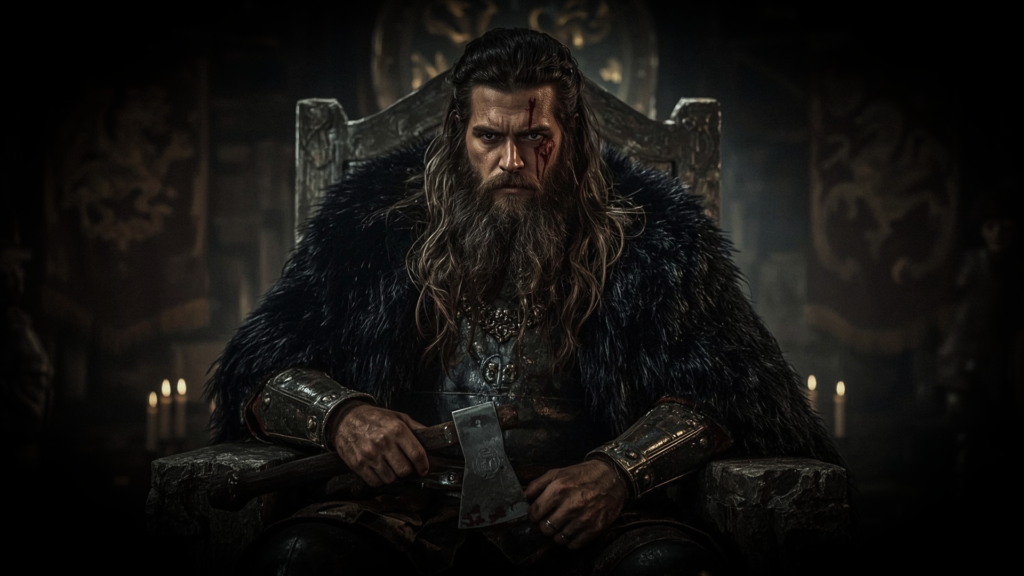
“He did not step out of his father’s shadow. He carved his own.”
THE MAKING OF A KING
Erik was Harald’s favourite. That much the sagas agree on. Given the best weapons. Given
the best ships. Sent raiding at twelve years old — twelve — sailing the coasts of the Baltic, the
British Isles, Francia, all the way to the shores of Finnmark in the frozen north.
By the time he was a grown man he had seen more of the world than most Vikings would see
in a lifetime. He had fought in more battles than he could count. He had stood on the prow of
his longship in storms that would have broken other men and felt nothing but alive.
Harald named him successor. Gave him Norway before he even died — the old king stepping
back, watching his favourite son take the throne he had bled for.
But a throne given is not always a throne kept.
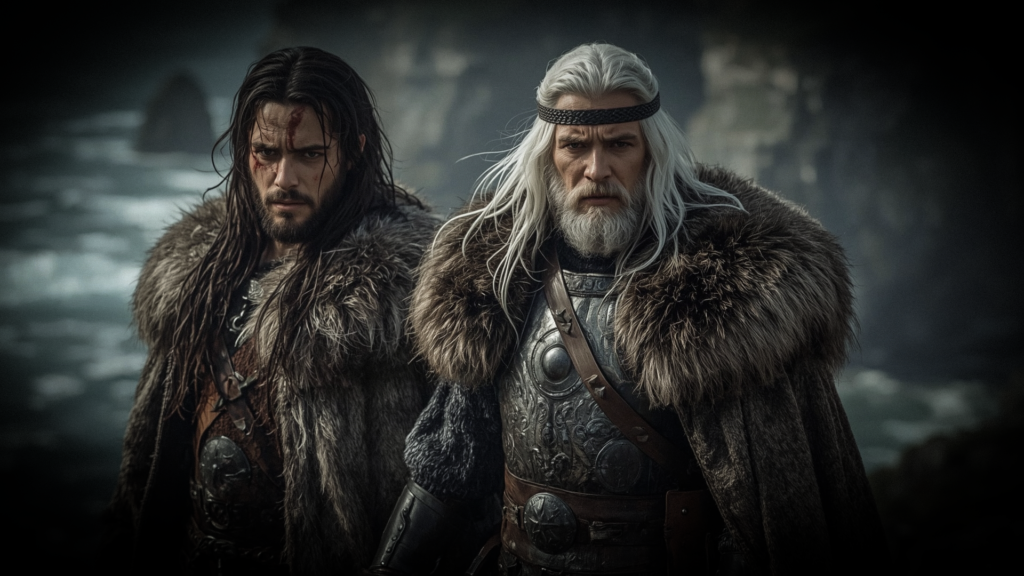
“A throne given is not always a throne kept.”
GUNNHILD — THE WOMAN BEHIND THE AXE
To understand Erik you must understand Gunnhild
The sagas describe her as the most dangerous woman in the Norse world. Beautiful, brilliant,
and utterly without mercy. She had studied sorcery in Finnmark — learned the dark arts from
Sami shamans in the frozen north. She could read the fate of men. She could change it.
Erik married her and from that moment the two of them were something the Norse world had
rarely seen — a power couple in the most literal sense. His axe. Her cunning. His violence.
Her strategy.
When Erik’s enemies multiplied — and they always multiplied for a man who killed his brothers
— it was Gunnhild who kept him one step ahead. And when Erik fell, it was Gunnhild who
survived him, outlasting kings, outlasting kingdoms, a grey shadow at the edges of Norse
history for decades after his death.
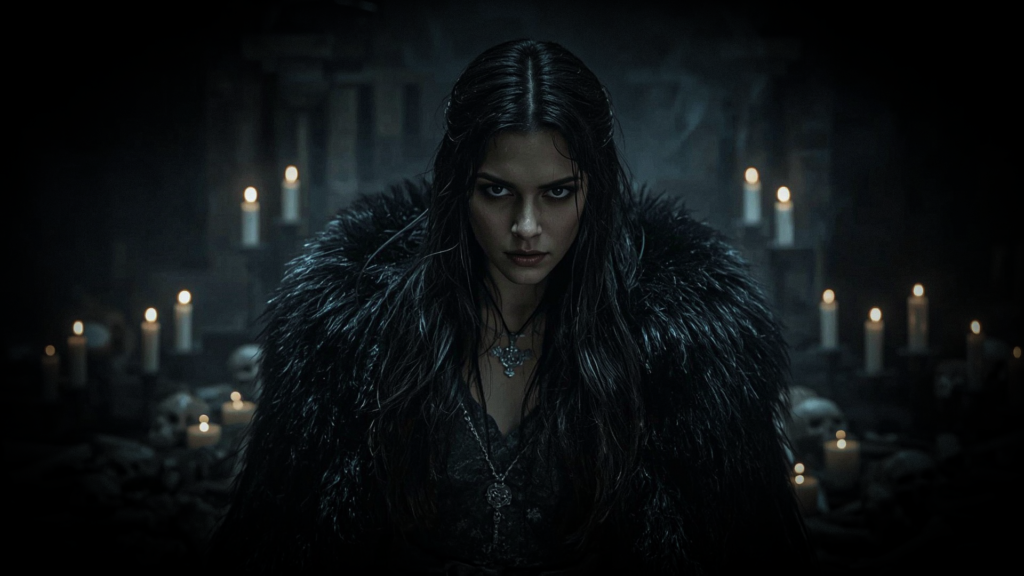
DRIVEN FROM THE NORTH
His downfall came from the one brother he had not killed.
Haakon — younger, quieter, raised as a Christian at the court of King Athelstan of England —
returned to Norway with an army and a different kind of power. Not Erik’s raw violence but
something more dangerous — the loyalty of the people. The Norwegian chieftains, tired of
Erik’s brutality and Gunnhild’s manipulations, sided with Haakon.
Erik fought. Of course he fought — this was a man who had been fighting since he was twelve.
But Norway slipped through his fingers anyway. Around 947, Erik Bloodaxe sailed away from
the country his father had built and that he had bled to inherit. He would never see it again.
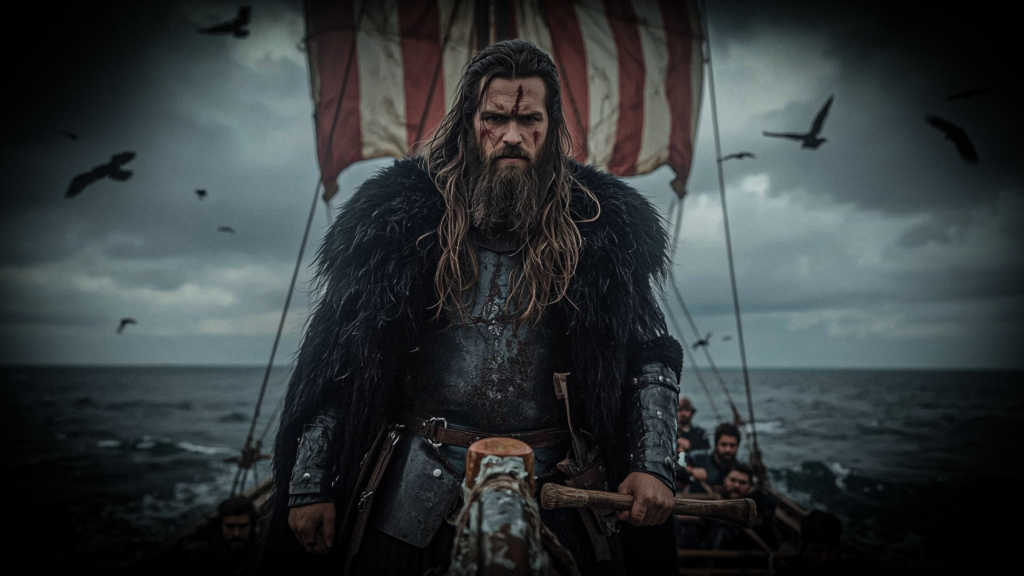
“Norway slipped through his fingers. He would never see it again.”
KING OF NORTHUMBRIA — TWICE
What happened next is the part of Erik’s story that most people don’t know — and should.
He went to England. Not to raid — to rule. The Viking kingdom of Northumbria, centred on the
ancient city of York, needed a king. Erik Bloodaxe, exiled Norwegian king with a fleet and a
reputation that crossed the entire Norse world, was exactly what they were looking for.
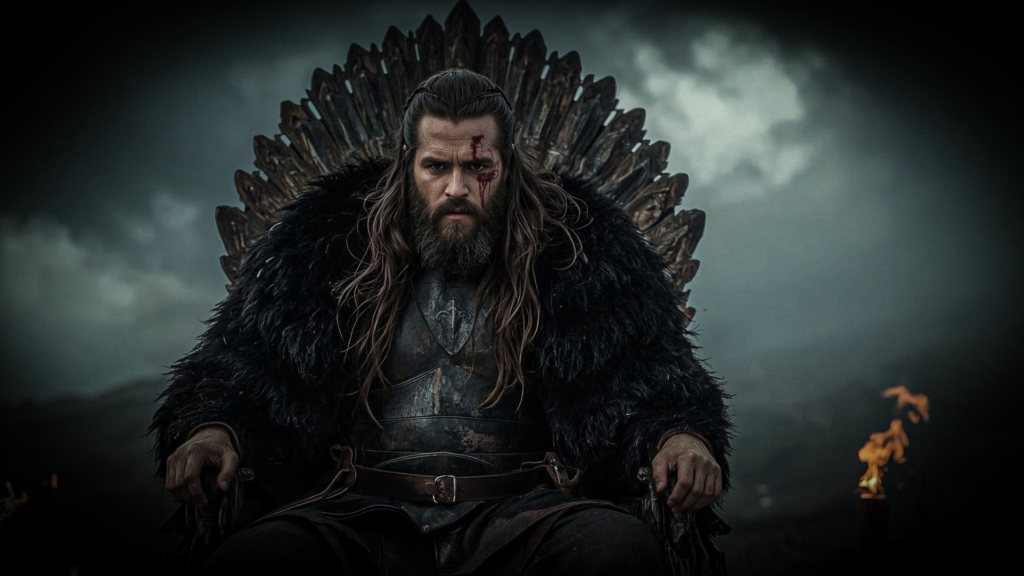
He became King of Northumbria in 947. Was driven out. Came back in 952. Ruled again until
954 — seven years in total on an English throne, a Viking king in the heart of Anglo-Saxon
England, holding a kingdom with sheer force of will and the terror of his name.
York under Erik Bloodaxe was one of the great Viking cities of Europe. Traders, craftsmen,
poets — the city thrived even under a king whose name meant blood.
STAINMORE — THE LAST STAND
It ended on a moorland in northern England called Stainmore.
954 AD. Erik had been betrayed — by Oswulf of Bamburgh, who had sworn loyalty and broken
it. Erik rode out with a small force, and rode into an ambush on the high moors.
He fought. The sagas are clear on this — Erik Bloodaxe did not surrender, did not flee, did not
beg. He fought until there was no one left to fight beside him and then he kept fighting anyway.
He died on that moorland with his axe in his hand. A king without a kingdom, a warrior without
a retreat, a man who had lived by violence and died the same way.
The last Viking king of Northumbria. The last of Harald Fairhair’s line to rule. The end of
something that had begun with the first longship and the first raid and the first Viking who
looked at the horizon and decided to cross it.
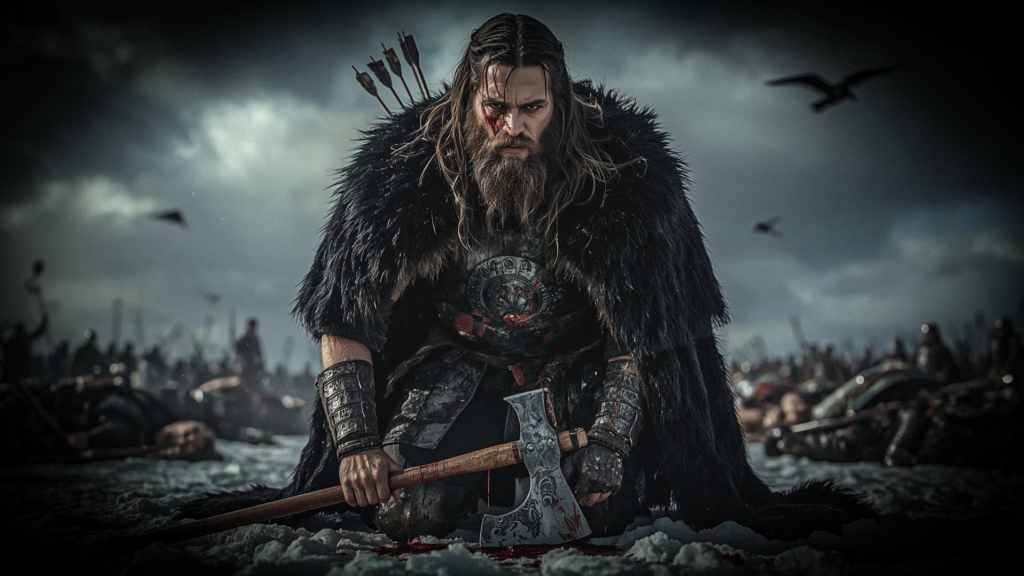
“He fought until there was no one left beside him. Then kept fighting.”
WHY ERIK BLOODAXE STILL MATTERS
Erik Bloodaxe was not a good man by any modern measure. He was ambitious, brutal, and
entirely without remorse for what he did to reach for power.
But he was entirely, completely, unmistakably Viking. He embodied everything the Norse world
valued — courage without limit, strength without apology, a refusal to bend even when
bending would have saved his life.
The skalds who composed poems about him — and there were many — did not write about a
monster. They wrote about a man who burned so brightly that the burning consumed him.
Eiríksmál, the poem composed after his death, imagines Odin himself preparing Valhalla for
Erik’s arrival — calling on the einherjar, the warriors of the hall, to make room for a king.
Even in death, Erik Bloodaxe walked through the right door.

“Even in death, Erik Bloodaxe walked through the right door.”